

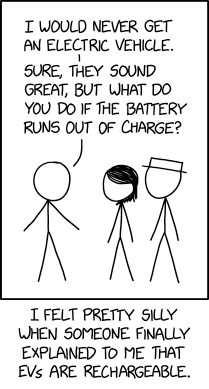
Title text:
Now that I’ve finally gotten an electric vehicle, I’m never going back to an acoustic one.
Transcript:
Transcript will show once it’s been added to explainxkcd.com
Source: https://xkcd.com/3214/
Title text:
Now that I’ve finally gotten an electric vehicle, I’m never going back to an acoustic one.
Transcript:
Transcript will show once it’s been added to explainxkcd.com
Source: https://xkcd.com/3214/
I guess an update is in order. I was thinking of a calculation that is already several years old. I can’t even find it any more, but it had three options: small gasoline powered ICE car, hybrid and a fully electric one. Can’t remember if the latter one was Tesla, Toyota, BMW or something. Anyway, at that time, TCO of a small gasoline powered car was a bit lower that that of a hybrid or a fully electric one.
The final tipping point will be when the demand for EVs exceeds the demand for other car types. When that happens, depreciation of gasoline cars will increase dramatically, giving EVs a lower TCO. At the moment, charging infrastructure seems to be the bottle neck for a many people, so that’s why we haven’t gone past the tipping point yet. The real bottle neck here is actually the electrical grid, and upgrading that will take many years, if not decades. We could install more charging stations, but that would break the whole grid, so that’s why we have to limit their number in specific parts of the grid.
The price of a new EV is obviously going to decrease in the future, as every step along the chain ramps up production. Alternative battery chemistries play a role as well, now that LFP cars have finally entered the market. I’m also looking forward to seeing how Na-ion batteries affect the prices, but that’s still going to take a many years. I expect that in about 5-10 years the prices of cheap EVs will be a lot lower than they are today.
The economics are basically always shifting. Real world depreciation and maintenance don’t always follow the model projections, and neither do actual fuel/energy price projections. Electricity service has skyrocketed in a lot of places in recent years, while gasoline prices have remained pretty low, which obviously affects the accuracy of the calculations and modeling that were done 5 years ago. Not to mention, both gasoline and electric energy pricing vary heavily between place.
And, of course, the ever changing regulatory landscape might affect pricing and resale value, as well.
Plus the thing with cars is that most people aren’t buying the absolute bare minimum they can afford. People are willing to spend more on things: passenger and cargo space, performance, aesthetics, features/comfort, exterior dimensions that fit their own needs (for example, people who live in a city and want a car that can fit in tiny spaces), etc. For someone who is looking at total cost of ownership of something like mid tier or even luxury model, they should be comparing specific models they’d consider.
Ultimately, people need to do the calculation for their own specific situations. Someone in the market for a minivan in Detroit is gonna have different considerations than the person looking for a pickup truck in Dallas or a luxury sedan in Los Angeles or an economy car in Honolulu.
And as things shift, we’ll likely see more people make the decisions that are right for themselves in that particular moment. Including people who want to pay more for something not directly financially beneficial to themselves, whether it’s the driver who wants a manual transmission and the sounds of a revving internal combustion engine, or the person who would rather spend a little bit of extra money to do something more for climate change. Or the person who wants to boycott Elon Musk and will spend a bit more getting another non-Tesla EV.
At this point, my next car is almost certainly an EV, but I’m not going to prematurely sell my current car to make it happen.
Recently I realised that my EV data needed an update. Previously I thought that everything even remotely affordable was automatically Nissan Leaf level of useless. Well, the cheapest ones still are, but within the affordable range there are some cars that aren’t trash. I was surprised to find something I could realistically consider buying.
As long as I can figure out a way to charge it, my next car will be electric. Currently, I can’t charge at home, so there’s a bit of a problem…
I only really know the U.S. market, but our top two selling new vehicles (Ford F-150 and Chevy Silverado) have a full EV options that are similarly priced as their gasoline counterparts. They start at $10k more than the entry level gasoline trim levels, but also have options/features included that are comparable to similarly priced gasoline trim levels. And these trucks are a bit unusual in that options and features can literally more than double the price while still carrying the same model name (cheapest F-150 is $40,000 and the most expensive is about $90,000 with full options).
Our third most popular vehicle is the Toyota RAV4, which is available as a plug in hybrid, but the plug in model doesn’t sell that well. But Toyota has been slow at actually wanting to build and sell EVs. The fourth most popular, the Honda CR-V, is primarily a traditional hybrid.
Skimming past some more pickup trucks, the seventh most popular selling car is the Tesla Y, and the most popular pure EV that isn’t available as any gasoline powered variant.
Looking at the actual EV platforms available in the US, most of the big plays from non-Tesla companies have happened in the last 5 years.
Volkswagen was a bit earlier than most, with a few specialized models launching in 2019-2021, but they didn’t really move that many units.
The Korean manufacturers Kia and Hyundai and their shared EV platform had a bit more success with sales volume, and started with 2021 models, so that their used EVs are becoming available on the used market.
GM’s big EV platform, the BEV3 (which also powers Honda’s EVs) launched with the 2023 model year, and most models started with the 2024 model year.
Ford has their Mustang Mach-E (beginning in 2021) and F-150 Lightning (beginning in 2022), but both of those are one-off platforms while they work to develop a modular platform for building multiple models with shared electric parts.
Skimming through the offerings by other traditional automakers, there’s BMW’s i series, which led to electric options for several of their models beginning in 2022, and Stellantis with a bunch of European models and a handful of American models hitting the market beginning in 2024 or so.
Pure electric manufacturers like Rivian, Lucid, Polestar have also released some models in the U.S., mostly released in the last 5 years as well.
So it really seems like the higher volume sales of new non-Tesla EVs picked up in the last 2-3 years, and there will be plenty of used options in the next 5 years. To me, it looks like an inflection point that can sustain EV as the default pretty soon.
Turns out a lot has happened in the past five years. It was about time I took another look at the EV market.
I narrowed it down to cars manufactured in 2019, and I found so many Nissan Leafs. Those are the kind you’d only want to drive when the ambient temperature suits NMC batteries. Maybe a third of the year, if you’re being generous. Not too long ago, those cars were new and really expensive, but still equally niche products as they are today. Many competing models had the same issues back then, and my perceptions were shaped by that era.
Another popular model seems to be the Renault Zoe. Some versions can heat the battery to optimal temperatures, so I guess a Zoe could be a reasonable option as long as you do your due diligence. These Zoes are now used and very affordable, so I’d say we’ve passed the point of no return. EVs are a viable option today. 😀
Well… assuming you have a place to charge it. Right now, I don’t, so it’s back to square one for me. 😞