Sounds like the right choice! I’m glad you got Debian up and running,


Sounds like the right choice! I’m glad you got Debian up and running,
I get paid by the hour! 😅 But for real though it’s a struggle. Mostly I try to use msys2 for everything but. I still have native git. There are some long standing bugs that make the vim excruciatingly slow to open or close, really I should go try to fix it but it doesn’t feel like a fun problem.
For work, I just use windows. Not my machine not my problem.


Don’t be afraid of the command line, breaking Linux is how you end up learning how to use it!
I haven’t done this tutorial but if that kind of thing helps you this one looks pretty good.
My best guess is you need to do something like:
(In the shell, one line at a time, enter runs the command)
mkdir /mnt/tmp
mount /dev/sda2 /mnt/tmp
nano /mnt/tmp/etc/fstab
Nano is a text editor that uses your whole terminal, so you will see the contents of /mnt/tmp/etc/fstab (the file that controls where disks are mounted) and replace ‘sdb’ with ‘sda’ on the line starting with /dev/sdb2. The bottom of nano’s screen shows you the keyboard shortcuts, I think Ctrl W will make it write the file, asking for confirmation of the filename, which should stay the same. Exit nano (Ctrl+x maybe?) then reboot with the command ‘reboot’
If you get any errors about access denied or permissions, run ‘sudo bash’ to get a shell with more power and try again.
Good luck!
What most likely happened is your disk order switched and, as others have mentioned, using /dev/sda1 or something similar to point to partitions is unstable and can’t be trusted. Once your system is back up, look up how to specify partitions in /etc/fstab using UUID (something like /dev/disks/by-uuid/xxxx-xxxxxxxxxx-xxxx instead of /dev/sda2)


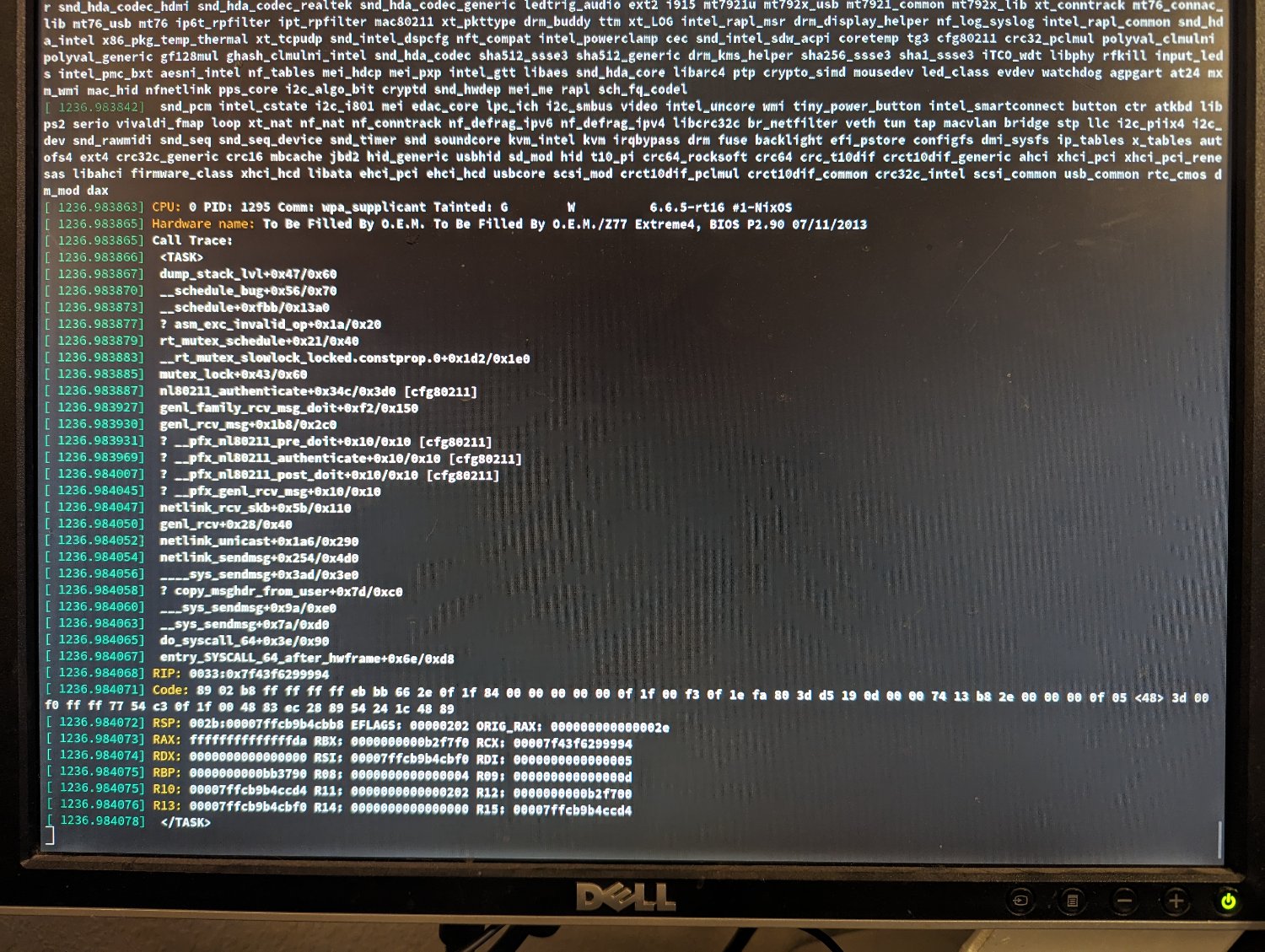
When this happens to me I mostly assume Linux shutdown automatically because of a critical over temperature event. I’ve seen it in the logs a few times but I don’t usually check anymore.
There’s an example of this here https://unix.stackexchange.com/questions/502226/how-do-you-find-out-if-a-linux-machine-overheated-before-the-previous-boot-and-w


Idk I just bought a 32GB stick of ddr4 sodimm for $60, adapters are less than $10 each so maybe not if you stay away from scalpers and don’t pay attention to ram speed 😅
I was also thinking the soldered CPU motherboard with 8 cores must cost at least 200 but maybe that’s a bad assumption and I didn’t look it up.


Looks like most of the nibbles are fine. Maybe something happened to the connectors or traces. At least you know it’s the ram not your motherboard.
Also, what do you mean by crashes? Kernel panic? Random app death because the oom killer was activated should be expected when pushing the memory limits on Linux.
I’m running 8 and 32 in my T490, seems to work fine. I’m building software and leaking memory like crazy and it’s never been weird. I don’t see why 8 + 32 would be any different than 8 + 16 other than capacity.
Doesn’t the channel balance not matter that much? Like operations can be done in parallel. I always thought the benefits came from reading different things from each ram chip not synchronizing them byte for byte.
Check your disk usage with df -h
When my machine gets weird it’s always out of disk space.


Agreed, you can probably get away with an extension that updates the file icons when the default app changes, and syncs all of them when you press a button somewhere or install it.
Yes. Gentoo is always a good idea :)


I find it amusing. I’m a die hard Linux user, but I never “switched”. I still have windows machines I just don’t like them.
Bruh is your CPU even source available?
The only option for true transparency is to build it from scratch, like at the logic gate level.
Those distros have ethical and legal value but they don’t magically make you better off.


Fyi UAC is not strong protection . Also, it really doesn’t matter if you have a password or not, UAC works the same way.
SELinux or other MAC systems (AppArmour?) are complicated but can protect a Linux system in a way similar to the UAC prompts on Windows, although its not convenient at all.
Maybe someone has a gui to make it easy, but I’ve never used it.
I think you may be happy with setting a short or empty user password so a sudo popup is basically the same as clicking allow on a UAC prompt


Let’s see how this goes then revisit the question.


I’m sure windows activation will complain, but you should be able to dd your windows partition (or disk) over to the external disk, set up a bootloader (windows can do this, but something like grub or syslinux I know would work to hand off to the windows bootloader)
I don’t know anything about bitlocker stuff, probably needs to be decrypted before this can work.
That’s what I would try, even though it’s not wrapped up in a single tool.
Renoise is sweet as far as trackers go.
Ardour was always my go-to although it’s been crashing on me a lot.
Shout out to BespokeSynth for being amazing, I forgive the crashes because it’s so cool and strongly foss.
Resentment is usually a feeling which has little to do with ethics.
Actions are more easily analyzed for ethical value.
I guess that you’re considering the action of showing resentment by being absent or cold to them.
From a utilitarian perspective this could serve the purpose of communicating your resentment indirectly which may increase the overall good by preventing this scizsm from infiltrating other parts of your life and others. On the other hand this outcome is not guaranteed.
If you apply value ethics of your actions it really depends on what ideals you hold yourself to.
If you take a completely honest person as your ideal, direct communication is probably more ethical than indirect communication, but indirect communication would still be superior to deceiving them into thinking you agree with them in any way.
Instead, you may idealize an honest pacifist who would value indirect communication higher than direct if direct would also come with conflict.
These are my thoughts, I am by no means an expert in ethics.
I think xvnc does this with vnc. If using gnome start gnome-remote-desktop with systemctl --user start gnome-remote-desktop then use grdctl to set it up (or the settings gui). I’ve had luck with rdp on a Wayland session this way.