

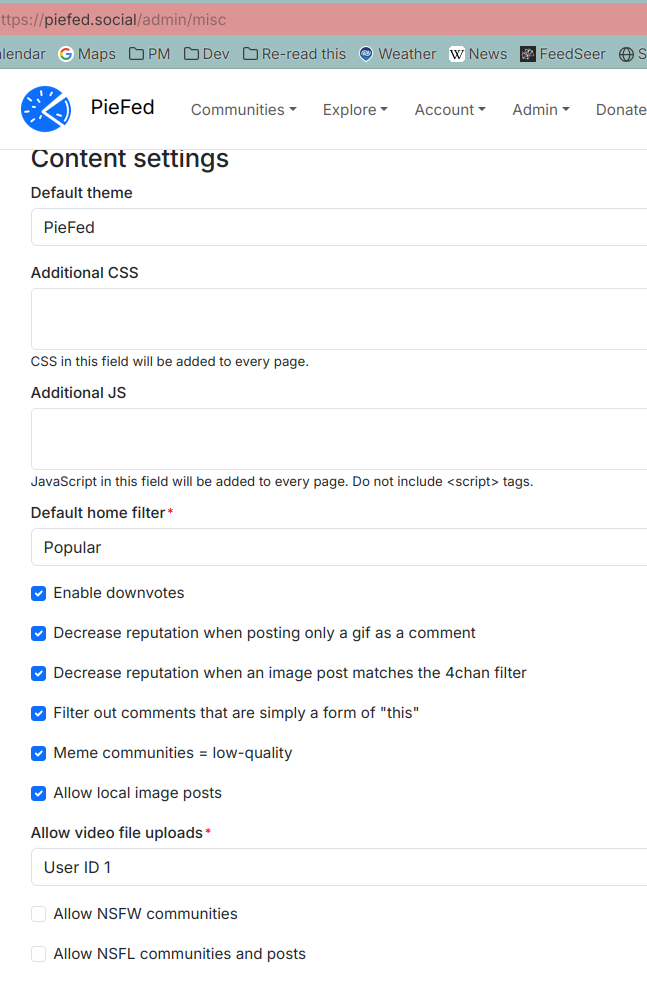
Edit about the 4chan image blocking, I asked Rimu directly:
I wrote a long message about how that checkbox only notifies about federated posts.
So the difference is for local posts it blocks the creation of the post entirely, but for federated posts it just notifies the admin.
https://chat.piefed.social/#narrow/channel/3-general/topic//near/10529
– Original message:
A few people in the other thread assumed that it was required to fork the code to disable those filters. That’s not the case, the filters can be configured, and are off by default.
To hide the reputation system, here’s a line of CSS that admins can add in the admin area to hide it for every user
That CSS line can also be used by any user wanting to hide the score at the user level.
Those checkboxes have been there since version 0.9. Ages.
The problem with grabbing small snippets of code is a lot of context is lost. Don’t trust anyone who does that. PieFed has 50,000 lines of code so anyone showing you 50 lines is leaving out 99.9% of the picture.
As I said a month ago, anyone with honest questions about how things work who wants to make PieFed better knows where to find us. You don’t have to be a coder, we need translators, designers, documentation writers, bug reporters, community evangelists and all that.
To me, it was obvious that these parts were configurable. There were literally boolean checks for it.
But these features remind me Reddit. And I’m pretty sure most users simply unaware about these things enabled on the .social instance.
These 2 statements are incompatible.
Plus depending on the snippets they definitely can tell how things work
Previous threads about these filters were people complaining about them being hardcoded, completely ignoring that they are completely optional and off by default. It would go something like this:
Look at this awful thing PieFed does!
def do_the_thing():
    # relatively simple code that does the thing
It completely ignored the context that the
do_the_thingfunction is only called if the admin wants to do the thing.Most of the issues people have brought up have been about why the snippets are even in the code not trying to obscure what the code does.
Again it’s why is this a thing
Simple != few lines of code, nothing incompatible about those two statements
Saying the simple code needs lots of context outside of the code block says it’s either not simple or not easy to understand
« The problem with grabbing small snippets of code is a lot of context is lost.» does not mean that a lot of additional code is required to understand the context, additionally, simple code may require you to read a bit of code to understand it.
Simplicity does not mean small scale, nor that it must be understood at a glance.
Rich Hickey got a great presentation where he discuss simplicity vs complexity. It’s worth a watch if you want to better understand the concepts.
https://www.infoq.com/presentations/Simple-Made-Easy/
The 99% of the code does not deal with keeping Shadow Profiles on netizens and punishing them (as well as misinforming them about what’s going on). This 50something lines, does, and thus is a weighed key on which to judge the subject.
What will they be commenting to the public on the CCP-like thing?
“Shadow profiles”? Huh?
Yeah. You know, Shadow Profiles? Datasets on users collected for the purpose of control and manipulation, basically the equivalent to back when McCarthynism and the FBI had a “dossier” on you. It’s not even that old, Facebook was caught doing it in a big scandal and pretty much every corporate since then (Reddit uses it for shadowbanning Fediverse mentions, etc).
That’s not what’s being done at all here. It’s not that deep. It’s just a number based on downvotes received/given.
Why the constant shitting on “tankies” if you’re gonna have a social credit score?
deleted by creator
get back to work hardcoding censorship and pushing your tankie ideology in your code.
What is wrong with you? Why would you put malicious code into piefed that deliberately misleads users?