

- cross-posted to:
- selfhosted@lemmy.world
- selfhosted@lemmy.world
- cross-posted to:
- selfhosted@lemmy.world
- selfhosted@lemmy.world

Me again :P
Honey, I Shrunk The Vids is a streamlined video conversion tool built on FFMPEG, with smarts built in for standardising all files put through it to a standard target bitrate into either .mp4 or .mkv containers, in either h.264 or HEVC format. Comes in GUI for desktop and CLI for headless operation. The idea is that you can point it at a folder full of folders full of videos and hit “Start”, and trust that when it’s through you’ll have videos compatible with devices back to ~2014, smaller (or at least no bigger) than they were before, and with accurate MKV tags where appropriate.
The application has gone through some more major revisions since my last post, and I thought people would like to know! The first thing you’ll notice is the visual refresh:
Screenshots
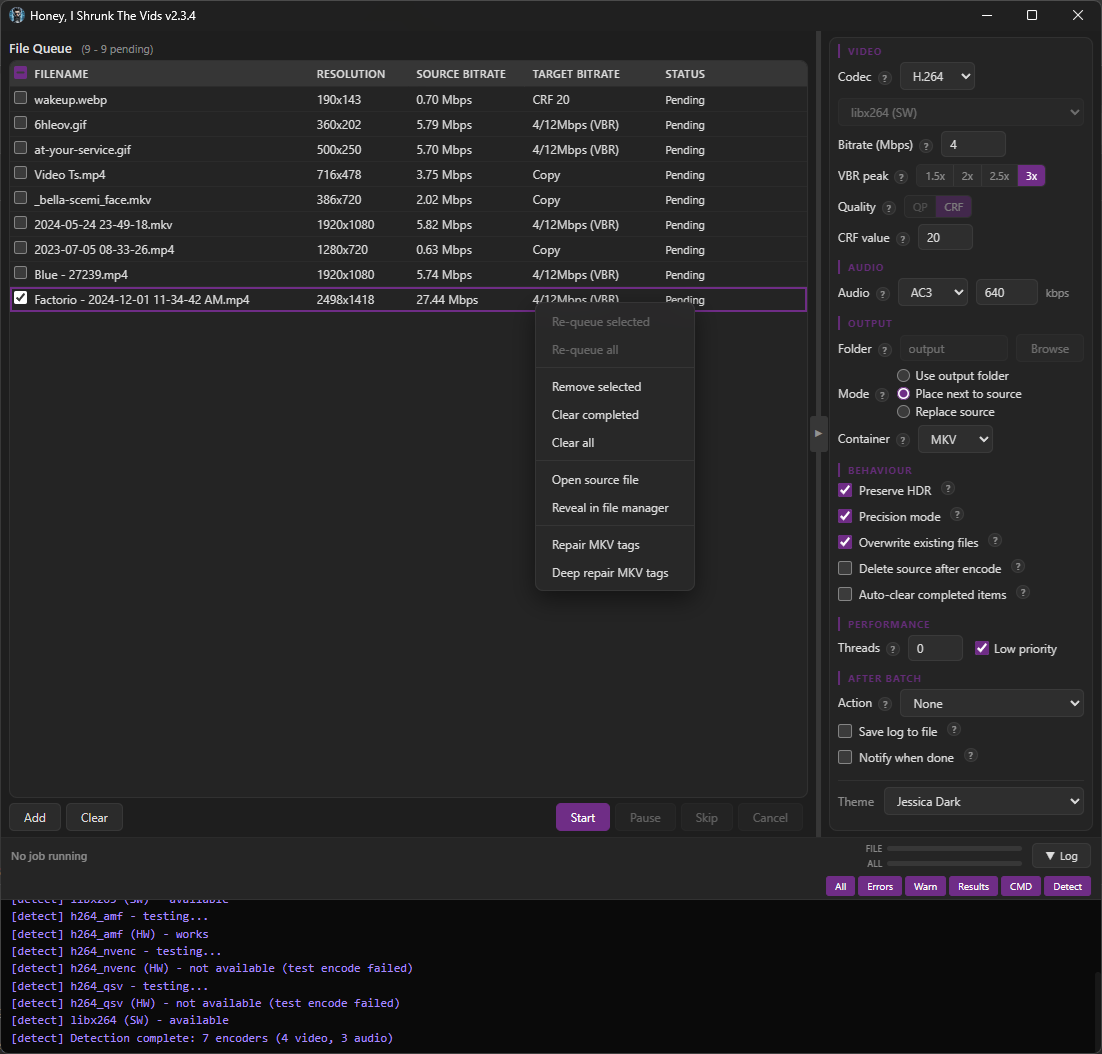
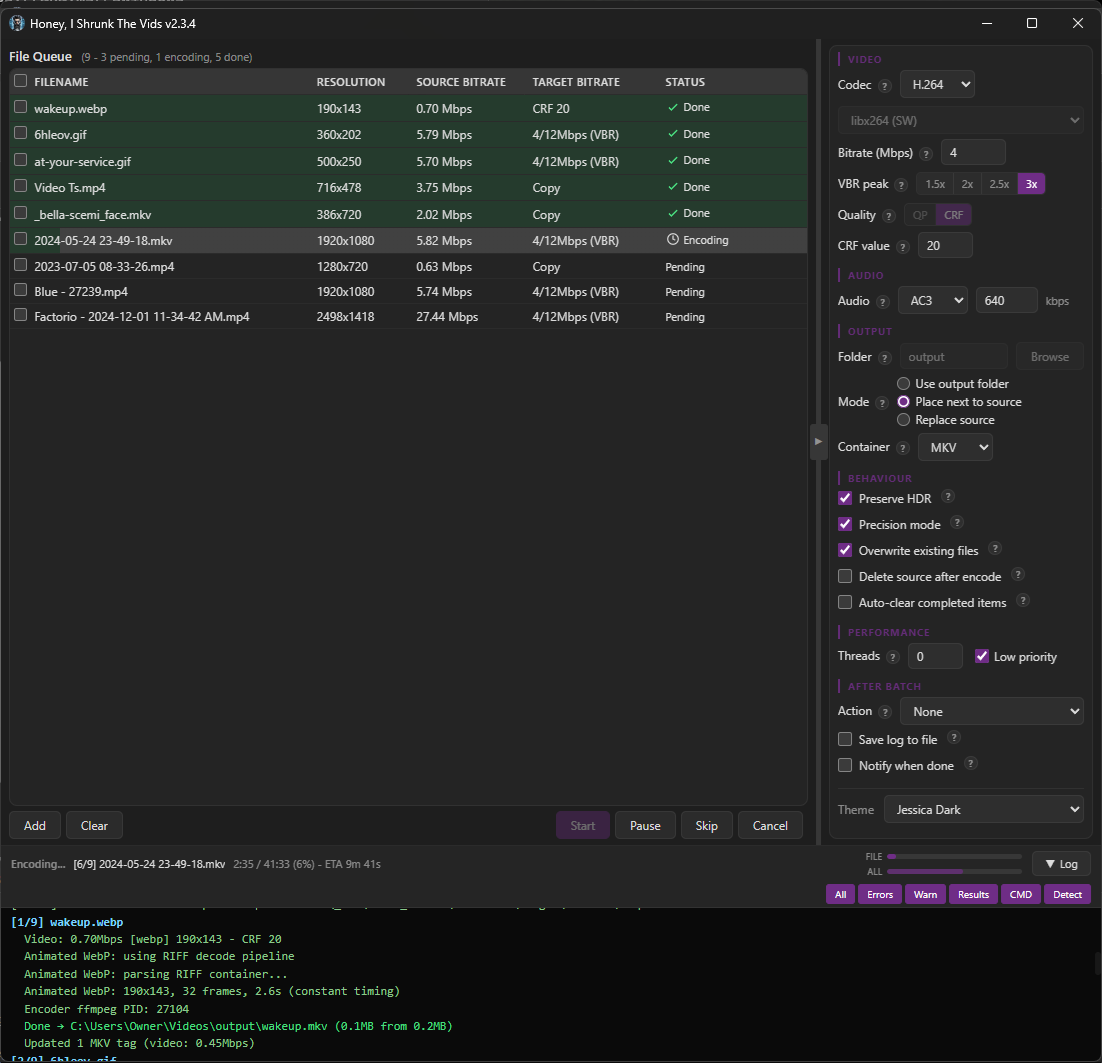
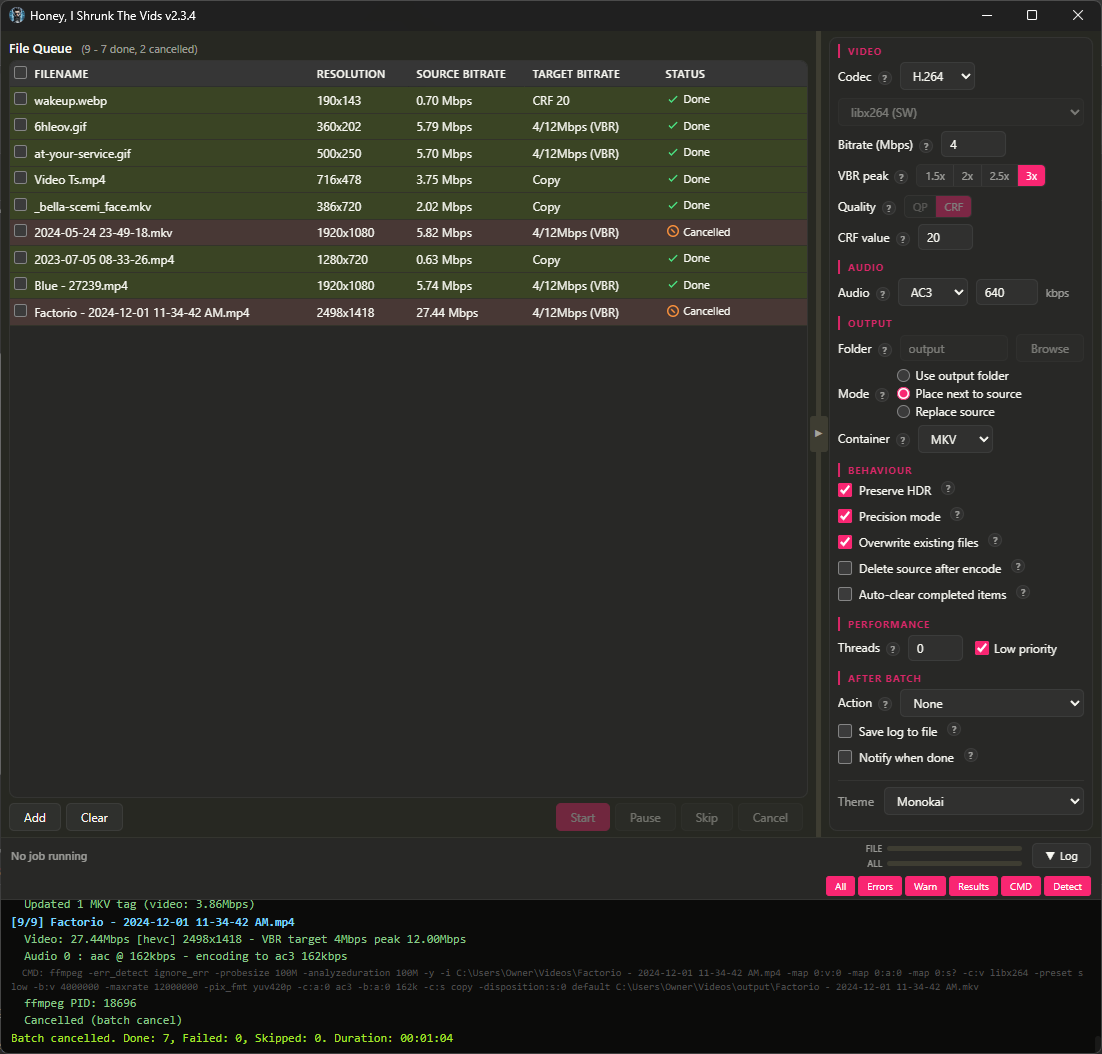
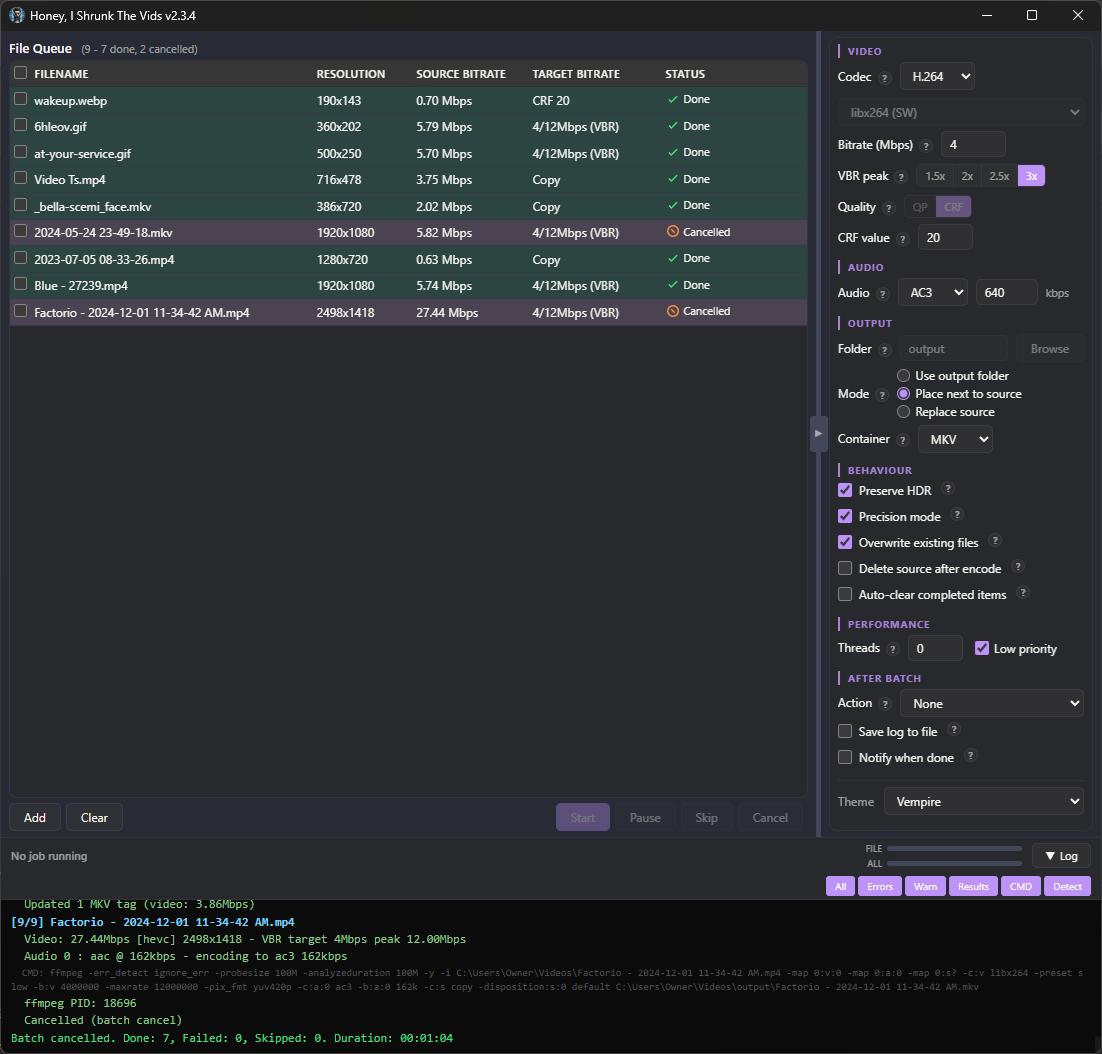
There are no more menu tabs; all options are exposed in a single side panel. Also, I added exotic filetypes for inputs: mts, mpg, mpeg, vob, flv, 3gp, 3g2, ogv, rmvb, rm, asf, f4v, y4m, apng, webp. That’s right, you can convert basically anything FFMPEG supports to convert to MKV or MP4!
I’m particularly proud of the webp support. FFMPEG can’t decode animated WebP natively (or at least, the most popular binaries can’t; maybe someone has a fork that’s fixed it), so HISTV:
- Parses the RIFF container itself,
- Decodes each frame through ffmpeg’s static WebP decoder,
- Composites them with correct alpha blending and disposal, and
- Pipes the result to the encoder.
Temp files are completely avoided for storage/IO reasons; variable frame timing is preserved, so smooth per-frame progress is retained from source.
The one filetype I left out was .yuv, because that’s raw data, no container or headers, and the user would have to enter the correct dimensions for each video (which defeats the core purpose of Honey, I Shrunk The Vids, so it’s out of scope for this project).
The theme engine has been simplified, with only 6 keys down from 16, and everything named more intuitively so it’s easier to tell what changes what. As well, a Linux user reported their FFMPEG wasn’t discovered properly, so ffmpeg discovery now uses login-shell PATH resolution (previously macOS only), fixing detection when ffmpeg is installed to locations like ~/.local/bin.
Bunch of bugs got squished (for example the encoder would switch when toggling the new “Precision Mode” checkbox), and several more efficiency passes were made with more hand-edits than ever. This is the cleanest, leanest build yet, and the most featureful.
Finally, I added “-full” versions for each platform. These come bundled with FFMPEG, if you want just a single download.
Also, I’ve flirted with the idea of signing the Windows executable so Windows Defender stops complaining about it, but I don’t yet see a reason to give Microsoft money for that. You can just click “More Info”, and then “Run Anyway”.
I’m running out of ideas for future updates, but if anyone has requests just drop a comment or open up an issue! And, as always, I’m here for questions. I hope you find it useful!
Has anyone tried this? OP, have you? Is it fast? I have a tv show that I’ve ripped from blue-ray. It is 600GB and I wanted to save some space, but whenever I try to convert, it’s awfully slow. I have a pretty beefy setup, Ryzen 7 5800xt CPU and a 9070xt GPU.
afaik if you want to retain as much quality as possible while saving space you do want to do it on the CPU (so not hw accelerated - slow)
Haha yes, I use it regularly! And yes, it’ll be plenty fast on your system. I have very deliberately gone over the code base looking for inefficiencies six times now, so it runs nice and lean - I do an efficiency/hygiene pass every couple of releases to make sure bloat doesn’t creep in.
As ark3@lemmy.dbzer0.com said, CPU encoding is slow but it preserves the most quality. No kidding, it really is night and day compared to GPU encoding - for this, just tick “Precision mode” in HISTV. It’s about 1x speed on most videos, so a 45 minute file will take about 45 minutes.
GPU does go a lot faster, my 7900 XTX rips through 1080p at about 28x speed so a 45 minute file takes about 2 minutes. This is good enough for most content; just untick “precision mode” and set the multiplier to 2x or 3x with a bitrate of 4 if you want better GPU quality in HISTV. The multiplier says how high the peak bitrate can go, so you keep more data for fast-moving scenes, without forcing the encoder to keep useless data for slow scenes.