
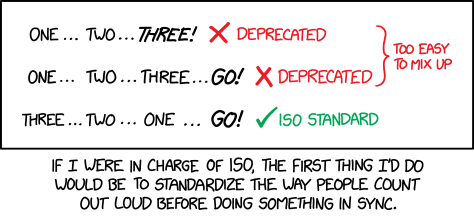
xkcd #3232: Countdown Standard
Title text:
Anyone who is caught counting ‘three … two … one … zero … GO!’ will be punished with a lifetime of eating only ISO standard food samples.
Transcript:
Transcript will show once it’s been added to explainxkcd.com
Source: https://xkcd.com/3232/
For many, “next Thursday” is the next available Thursday, three days hence (if you’re reading this on a Monday)
What the fuck. 😭 But “next Thursday” clearly has a well-defined 7-day period. Given a bus stop with 20 minutes between buses, the “next bus” doesn’t just start arbitrarily applying 10 minutes after the last bus left. Who would use it like this??
The next bus is the next bus to come 🤷🏼♂️ But the answer to your question is enough to not know for sure what the other person means without clarifying. It happens especially when someone is talking about “next Thursday” on a Friday for example. Because that’s in next week.
This doesn’t make sense from a linguistics standpoint though. So next Thursday is the Thursday this week, but next week isn’t this week, it’s the week after this one. So what’s the Thursday in that week, the next next Thursday? It just doesn’t work.
Anything in this week (Sunday-Saturday or Monday-Sunday) even stuff from a few days ago -> this <day of the week>.
Anything from last week -> last <dotw>
Anything in next week -> next <dotw>
It’s incredibly simple and it’s logically consistent and it works in every situation unless you are talking to someone from a different country that uses a different starting day. And even then it works the majority of the time.
You’re trying to apply logic to English? You’re also assuming people actually think about what they’re saying or even know the so called rules of English. If that were the case we wouldn’t have people mixing up their/there/they’re or your/you’re its/it’s etc.
Fact of the matter, if everything you said were true, we wouldn’t have people wishing for a way to clarify and we wouldn’t be having this conversation.