

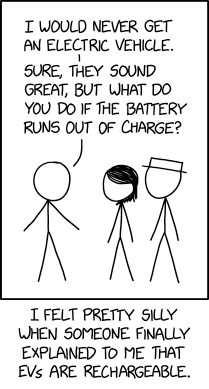
Title text:
Now that I’ve finally gotten an electric vehicle, I’m never going back to an acoustic one.
Transcript:
Transcript will show once it’s been added to explainxkcd.com
Source: https://xkcd.com/3214/
Title text:
Now that I’ve finally gotten an electric vehicle, I’m never going back to an acoustic one.
Transcript:
Transcript will show once it’s been added to explainxkcd.com
Source: https://xkcd.com/3214/
Depreciation is a massive slice of the pie in all cars, but EVs are hit even harder. Buying a used EV is probably my best bet in about 5-10 years from now.
Specific cost of ownership (as in €/m) is what actually matters in the end, but most people ignore it. Usually people just compare gasoline and electricity prices and draw their conclusions based on that. That sort of analysis is not going to give you a very reliable picture.
Regardless, if I had the money to drive a BMW, buying an EV would be a simple decision. Who cares about the purchase price, ongoing expenses or depreciation when you have that much money. Since I’m not in that market segment, EVs aren’t really a viable option for me just yet.
TCO is even better for electric. Near zero maintenance. The depreciation is real, but only if you plan to sell it at it’s half life. If you plan to hold it a long time, depreciation evens out.
My EV is ten years old and cost $30k. It’s paid for itself twice over in just gas. More if I factor in the zero maintenance (not totally zero. I changed the tires a few times and had to replace a trunk component). The resale on it is about $8k lower than an equivalent ICE. But for me, the EV was a good deal.
I’d definitely recommend getting a used one though. I bought mine new, and that makes the numbers worse.
It’s not though, or it is currently. It wasn’t too many years ago that teslas kept their value more than any other car. I’d argue this is a temporary market condition that is only valid for decisions now but is not predictably valid
I lean the other way. I think Tesla valuation was artificially hyped and manipulated. The car’s valuation was luxury priced and tied to Elons personality. And that tanked. So I personally don’t think that was normal or ever coming back.
I think the current conditions are also abnormal, with EV becoming political and a horse running amok in the white house.
The normal depreciation is probably in the middle. But when are things ever normal anymore?
Yeah normal seems to have taken a vacation
In either case it’s all tied to supply and demand. When teslas kept their value it was because huge growth they couldn’t keep up with. Now their value used is horrible but a big part of that is demand dropped, so they can make too many.
And yes it is not a good thing that in both cases too much was driven by a personality.
Personally I’m annoyed because teslas still are the most compelling EV available to me, but they always had the shadow of over-hype and now they’re toxic
In practical terms, maintenance used to be a bottleneck. Didn’t know if it still is. If you always need to go to Tesla for maintenance, it’s going to get ridiculously expensive.
And then there’s the philosophical side. Who wants to drive a car associated with filth like Elon.
Other than that, getting a used Tesla could be nice.
I’m pretty sure maintenance still is a bottleneck. I did have to get warranty work done and the wait was significantly longer than I’ve waited for warranty work on traditional cars. I haven’t read much about it in the last year or though, so who knows.
But do you even have to goto Tesla? Certainly the drivetrain and any software is highly proprietary but it also rarely needs attention. The shop I use for inspections claims they can do wear items like tires, brakes, suspension
Body work on the other hand is probably a nightmare. Actually it’s a nightmare for traditional vehicles and can only be longer for Tesla based on lack of parts inventory
The way I see it, rich people can buy new cars. Everyone else who needs one should consider buying a used one instead. After a few years, depreciation isn’t quite so rapid any more, which makes TCO less of a burden.
Maintenance expenses do increase as the car ages, but as long as it isn’t like 25 years old, it’s not completely absurd. Currently, I’m looking to buy something that is about 5 years old, and then sell it when it begins to require frequent maintenance. That way, I should be able to avoid the two expensive extremes.
However, there’s another nasty twist. Cold environment will murder the NMC cells in no time. Not too long ago, I had to leave my car in a cold parking lot for a long time, and when I got back it was about -30 °C. Fortunately, I don’t need to abuse the engine this way any more than maybe twice every year. Oh, boy did it sound unhappy with that cold start, but it managed it anyway. If I had an EV, I would probably need to leave it at home, and take a bus for horribly timed trips like that.
Let’s say, about 6 times a year, I’ll have badly timed trips, with temperatures hovering around +5…-15 °C: That isn’t a complete disaster for EVs, but it’s still very bad for the cells. Some cars have a built-in heating system for the battery, so I guess that feature would see frequent use. When I’m eventually buying a use EV, having a battery heating system is going to be a completely non-negotiable feature.
We’ve just come off a cold streak like this and I have to say it was no big deal.
Obviously I don’t know of there are long term effects on the battery but
The only good things about NMC cells is the energy density and the ability to pull a decent power during acceleration.
When it comes to temperatures, they are surprisingly picky. Too hot or cold, and they wear out quickly. If you push beyond that, you’ll lose range instantly. That’s why a heat pump is such a great thing to have.
Also, the state of charge matters to longevity. If you use the wrong percentages frequently, you’ll start losing capacity sooner or later. Even if you treat the battery perfectly, it’s still going to wear out like the tires do, but this thing costs as much as an engine.
I’m really looking forward to seeing all the other battery chemistries take their share of the market.
The most hopeful part about those other chemistries is we already have nmc demonstrated to last beyond the average life expectancy of a vehicle…. And most of those newer chemistries should last significantly longer
I think that’s a quirk of Tesla trying to preserve market share by aggressively cutting prices of their new models over the past 5 years, which naturally puts pressure on all used models on the road. I don’t think that can last.
If EV manufacturers are racing to compete on price, then the new EVs will get cheaper faster to where EVs are cheaper than ICE vehicles new. And if the EV manufacturers stop cutting prices, then that will alleviate that depreciation pressure.
I guess an update is in order. I was thinking of a calculation that is already several years old. I can’t even find it any more, but it had three options: small gasoline powered ICE car, hybrid and a fully electric one. Can’t remember if the latter one was Tesla, Toyota, BMW or something. Anyway, at that time, TCO of a small gasoline powered car was a bit lower that that of a hybrid or a fully electric one.
The final tipping point will be when the demand for EVs exceeds the demand for other car types. When that happens, depreciation of gasoline cars will increase dramatically, giving EVs a lower TCO. At the moment, charging infrastructure seems to be the bottle neck for a many people, so that’s why we haven’t gone past the tipping point yet. The real bottle neck here is actually the electrical grid, and upgrading that will take many years, if not decades. We could install more charging stations, but that would break the whole grid, so that’s why we have to limit their number in specific parts of the grid.
The price of a new EV is obviously going to decrease in the future, as every step along the chain ramps up production. Alternative battery chemistries play a role as well, now that LFP cars have finally entered the market. I’m also looking forward to seeing how Na-ion batteries affect the prices, but that’s still going to take a many years. I expect that in about 5-10 years the prices of cheap EVs will be a lot lower than they are today.
The economics are basically always shifting. Real world depreciation and maintenance don’t always follow the model projections, and neither do actual fuel/energy price projections. Electricity service has skyrocketed in a lot of places in recent years, while gasoline prices have remained pretty low, which obviously affects the accuracy of the calculations and modeling that were done 5 years ago. Not to mention, both gasoline and electric energy pricing vary heavily between place.
And, of course, the ever changing regulatory landscape might affect pricing and resale value, as well.
Plus the thing with cars is that most people aren’t buying the absolute bare minimum they can afford. People are willing to spend more on things: passenger and cargo space, performance, aesthetics, features/comfort, exterior dimensions that fit their own needs (for example, people who live in a city and want a car that can fit in tiny spaces), etc. For someone who is looking at total cost of ownership of something like mid tier or even luxury model, they should be comparing specific models they’d consider.
Ultimately, people need to do the calculation for their own specific situations. Someone in the market for a minivan in Detroit is gonna have different considerations than the person looking for a pickup truck in Dallas or a luxury sedan in Los Angeles or an economy car in Honolulu.
And as things shift, we’ll likely see more people make the decisions that are right for themselves in that particular moment. Including people who want to pay more for something not directly financially beneficial to themselves, whether it’s the driver who wants a manual transmission and the sounds of a revving internal combustion engine, or the person who would rather spend a little bit of extra money to do something more for climate change. Or the person who wants to boycott Elon Musk and will spend a bit more getting another non-Tesla EV.
At this point, my next car is almost certainly an EV, but I’m not going to prematurely sell my current car to make it happen.
Recently I realised that my EV data needed an update. Previously I thought that everything even remotely affordable was automatically Nissan Leaf level of useless. Well, the cheapest ones still are, but within the affordable range there are some cars that aren’t trash. I was surprised to find something I could realistically consider buying.
As long as I can figure out a way to charge it, my next car will be electric. Currently, I can’t charge at home, so there’s a bit of a problem…
I only really know the U.S. market, but our top two selling new vehicles (Ford F-150 and Chevy Silverado) have a full EV options that are similarly priced as their gasoline counterparts. They start at $10k more than the entry level gasoline trim levels, but also have options/features included that are comparable to similarly priced gasoline trim levels. And these trucks are a bit unusual in that options and features can literally more than double the price while still carrying the same model name (cheapest F-150 is $40,000 and the most expensive is about $90,000 with full options).
Our third most popular vehicle is the Toyota RAV4, which is available as a plug in hybrid, but the plug in model doesn’t sell that well. But Toyota has been slow at actually wanting to build and sell EVs. The fourth most popular, the Honda CR-V, is primarily a traditional hybrid.
Skimming past some more pickup trucks, the seventh most popular selling car is the Tesla Y, and the most popular pure EV that isn’t available as any gasoline powered variant.
Looking at the actual EV platforms available in the US, most of the big plays from non-Tesla companies have happened in the last 5 years.
Volkswagen was a bit earlier than most, with a few specialized models launching in 2019-2021, but they didn’t really move that many units.
The Korean manufacturers Kia and Hyundai and their shared EV platform had a bit more success with sales volume, and started with 2021 models, so that their used EVs are becoming available on the used market.
GM’s big EV platform, the BEV3 (which also powers Honda’s EVs) launched with the 2023 model year, and most models started with the 2024 model year.
Ford has their Mustang Mach-E (beginning in 2021) and F-150 Lightning (beginning in 2022), but both of those are one-off platforms while they work to develop a modular platform for building multiple models with shared electric parts.
Skimming through the offerings by other traditional automakers, there’s BMW’s i series, which led to electric options for several of their models beginning in 2022, and Stellantis with a bunch of European models and a handful of American models hitting the market beginning in 2024 or so.
Pure electric manufacturers like Rivian, Lucid, Polestar have also released some models in the U.S., mostly released in the last 5 years as well.
So it really seems like the higher volume sales of new non-Tesla EVs picked up in the last 2-3 years, and there will be plenty of used options in the next 5 years. To me, it looks like an inflection point that can sustain EV as the default pretty soon.
Turns out a lot has happened in the past five years. It was about time I took another look at the EV market.
I narrowed it down to cars manufactured in 2019, and I found so many Nissan Leafs. Those are the kind you’d only want to drive when the ambient temperature suits NMC batteries. Maybe a third of the year, if you’re being generous. Not too long ago, those cars were new and really expensive, but still equally niche products as they are today. Many competing models had the same issues back then, and my perceptions were shaped by that era.
Another popular model seems to be the Renault Zoe. Some versions can heat the battery to optimal temperatures, so I guess a Zoe could be a reasonable option as long as you do your due diligence. These Zoes are now used and very affordable, so I’d say we’ve passed the point of no return. EVs are a viable option today. 😀
Well… assuming you have a place to charge it. Right now, I don’t, so it’s back to square one for me. 😞