

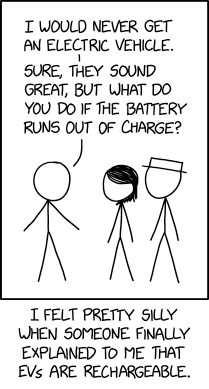
Title text:
Now that I’ve finally gotten an electric vehicle, I’m never going back to an acoustic one.
Transcript:
Transcript will show once it’s been added to explainxkcd.com
Source: https://xkcd.com/3214/
Title text:
Now that I’ve finally gotten an electric vehicle, I’m never going back to an acoustic one.
Transcript:
Transcript will show once it’s been added to explainxkcd.com
Source: https://xkcd.com/3214/
As an EV owner, I have recieved an interesting amount of reasons why people won’t buy them:
After this, they usually proceed to make absurd claims like "I don’t care, I just don’t trust EVs.
Very much similar to my own experience. The blackout is the funniest, because gas stations don’t work in a blackout, while solar panels do (assuming you disconnect them from the grid).
I would add one:
Oh, yeah! I forgot that one!
When you ask them how many times they found themselves with a thermic car doing 1000km without stopping they usually tell you: never, but what if I had to?
Bitch, if you need to do 1000km without stopping, you should be taking a train or a plane. Driving 10-12 hours without a single stop is bad and dangerous.
This was something I realized when we drive to my wife’s parents. It’s 2,000 km each way from our house in the US to where they are in rural Quebec, Canada and we usually drive it twice a year. The charging times sound long, but even with our petrol car most of our stops end up being between 15 to 30 minutes anyways between fueling the car, taking the dog to grass, taking turns going to the toilet so the dog isn’t alone in the car, getting food and giving me a chance to eat so I’m not trying to drive and eat at the same time.
I think the real challenge of electric range anxiety is that it still takes planning, at least in some parts of the US. There are areas on our route where it might be 100 kilometers to the next fast charger, and there’s no guarantee that all of them will be working or compatible with a car’s fastest charging speeds. We don’t really have to think about where we’ll get gasoline; there’s pretty much always a station, often several, within the next few miles. Usually if we’re waiting to stop for fuel it’s because we’re looking for the best price, looking for a place that might have decent toilets, and/or might have an appealing food option along with the gasoline. That’s all manageable in electric but might need some advanced planning, and many American drivers aren’t used to doing that kind of route planning in advance anymore.
How many cars in Europe can drive 1,000 km without stopping anyways? The only ones I can think of offhand are large American pickup trucks intended for towing large trailers long distances. I wouldn’t expect to see them in Europe.
Any diesel can drive more than 1000 km with a full deposit. But laws forbid in some countries to drive more than 2 hours or 300 km without stopping.
Some countries safety inspect vehicles annually.
I only recently learned that in the US not every state has annual inspection requirements. In fact it’s a minority of states, only 14, and it looks like the inspection requirements have been reduced in recent years, such as some states exempting new vehicles for a certain amount of time or only requiring inspections for commercial vehicles. Both states I’ve lived in had annual inspections and I just assumed it was a thing everywhere.
In Spain you have 4 or 5 years before the first safety inspection. And the then, if it’s a van or bigger it’s each 6 months and if it’s a car, 1 year.
I remember similar guidelines being taught when I was in driver’s ed in the US, but I don’t know if there were strict laws around it. If there are laws I would guess it is a state-by-state thing.
What if a comet was headed for your town and it has a radius of 500KM? Check and mate, libtard!
Americans do this on July 4 weekend, the highways are carnage.
The only somewhat valid use case for “driving 1.000km without a stop” would be several people in the car taking turns on the driver’s seat. While you’d technically need to stop to switch drivers this in itself is way quicker than even a quick charge on paper.
BUT: considering traffic jams, speed limits and such - a 1.000km trip would take around 10+ hours anyway. You’re not going to tell me that you do not even stop to pee or stretch a bit for 10+ hours, do you?
While growing up my family once a year would take a 20 hour car trip to visit extended family for a couple weeks then 20 hours back. Parents would do five hour shifts and get the whole thing done in one go. Shift changes meant refuel, bathroom, that’s it. Other than that there was no stopping unless it was a “the next bump in the road I will 100% shit myself” kind of an emergency
Now personally I’d argue maybe we shouldn’t have been taking road trips in that manner because it’s like putting your body through a meat grinder. But if trips like that are someone’s goal I doubt there are many charging stations in the middle of absolutely nowhere that can fully charge an EV in the time it takes to pee. I’m hoping though maybe a shift to EVs will change the way people approach long road trips to actually force them to take breaks
It takes just one small change …. My family did similar, but those stops were planned for mealtimes. We either did fast food or brought a camping stove, but always ate outside the car. Kids were encouraged to “run down to the end of that path with the dog”. Anyhow, the presence of even a fast food meal meant that there would have been plenty of time to charge.
My father in-law uses that added argument all the time. Who the hell needs to drive for 10 hours straight without taking a 30 minute break.
It’s the same mentality as V8 pickup buyers. But what if I need to tow my yacht one day? My truck was pretty damned convenient that day in 2017 when I had to move my brother-in-law’s sofa!
What ICE car goes 1000km without filling up?
A few diesels in theory if you drive economically
maybe on the internet. and we’ll just ignore all the pollutants Diesels spew.
A bunch of German diesels have 70L+ tanks and can comfortably cruise under 7L/100km at highway speeds. Passat, Audi A4, A6, and A8, BMW 3, 5 and 7 series, Mercedes C, E and S class.
So the trick is just burn more fuel!
My hybrid is running at 4.8-5 L/100.
That is under 7L too…
PS: if you had a 50L tak you car can do 1.000km too
deleted by creator
…do US statioms not have their own generators?
How are you going to fill those generators if the pump has no power?
Checkmate atheists
No idea about the US, but not in Europe. It was a major problem with the last blackout in Spain and Portugal.
I am asking because I worked in gas station in Poland and we had backup generator. xD
Nope. Even some US hospitals don’t have backup generators.
Another point to add for 9, all the EV parts can be recycled. The metal body is recycled in to new cars and battery components are also recycled in to new batteries.
Relevant technology connections video
https://www.youtube.com/watch?v=KtQ9nt2ZeGM
My reason for not buying an EV: it’s still a fucking car. Bit less shit, but still shit.
That should be Number 1 Reason to not buy an EV!
Agreed! EVs are certainly superior to ICE cars, but they’re a band aid instead of a solution.
Bring back public transit!
Well yeah if you can avoid it you shouldn’t buy a car, but if you have to buy a car you should buy electric
I mean, technically, an eBike is an Electric Vehicle, and not a fucking car. Otherwise, hard agree.
Fuck cars alright, but as long as I’m dependant on a car, my no.1 reason to get an EV is that I hate the oil industry even more. Fuck their oil and money and pollution and fuck their wars and politics.
With point 2 you can now use a real life case. Last year the Iberian peninsula had a blackout that lasted more than a day. The combustion engine cars could not pump petrol because guess what: pumps need electricity.
Eh? What if there’s a gas supply issue? Can’t fuel up. I’ve experienced this after a natural disaster disrupted gas deliveries. Lines for blocks. Days to wait.
Not to mention what if someone does something silly like start a war and push the price of oil up. Solar does not increase in price after it’s made.
YET. Elon’s working on it.
Doesn’t mean they can’t raise it :>
You can’t refuel a gas car without electricity anyway, the pumps are electric.
My argument: When I can get a decent used EV for $5k, I’ll do it. Until then, I’ll just get a decent used ICE car for $5K.
I always thought this was one of the reasons for an EV incentive. Encourage more people like me to buy the expensive ones sooner to develop the market, guaranteed demand for manufacturers, but that also gets us faster to the point of cheap used EVs
Haven’t seen anything decent at that price. You’ll be fine as long as you just drive in a city and keep the temperature of your car reasonable. If not, you’ll need to spend at least twice as much to get something decent.
The prices coming down though. We’re actually pretty close tolerable prices right now.
My reason: the hybrid I have is still working fine and a new car and a new car won’t be in my budget for the next 10 years or so. Also iirc about 33% of the energy a typical car will ever use is spend on its production, so it’s better for the environment to use a car until it breaks down.
that’s completely fine. If your car works, you shouldn’t throw it away, that is wasteful.
Depends on the car. Waste of resources sure, but it can reduce emissions depending on the car
Unless their car is scrapped, this only results in another car being on the road.
New drivers will be new drivers regardless. It will most likely just end up as a stored car or a replaced car of another car
Unless the ‘another’ car being replaced isn’t irreparably broken and just doesn’t suffice our MOT requirements, it’s probably ending in a 3rd world country and will remain in use there (probably instead a cheap light EV).
It sounds crazy, but I’d sit and wait the five minutes, much like I’ve done for pumps on occasion.
They couldn’t refuel their ice car either or how do they think the fuel is made to flow “uphill” from the tank in the ground into their car.
2: I wonder what those people think a gas pump runs on?
If there is no electricity, then those won’t pump either.
Here’s a financial argument. The initial purchase price is too high for me, and the depreciation of electric vehicles is also very high. Overall cost of ownership per distance driven is lower if I drive a small gasoline-powered car.
I really don’t want it to be that way, but that’s the reality I have to deal with. Cheaper EVs are coming, but they still aren’t in my price range.
Update: Yes they are. Needed to update my data. Used EVs aren’t expensive trash any more. Some of them are actually quite reasonable.
Must be a Europe thing. I ran the numbers in America and avoiding gas cost (vs electric cost per mile) means the car paid for itself after 30k miles. And that’s ignoring that it needs no maintenance.
I thought European gas was expensive. Is the electricity over there also really pricey?
I bought a used hybrid in 2020 when gas was cheap. It’s already 100% paid for itself.
People are morons and don’t do the 5 year math on what a vehicle costs to run.
It depends where you live. We have cheap gas and I live in an area with one of the more expensive prices for electricity (and there are worse), but “filling up” at home is much cheaper than “filling up” my ice car.
However
Perfect time to buy one then
Yes, I’ve argued that too. While there is the factor of fast changing technology, I think used EVs are a great buy right now.
I’m not in the market for an additional car although I’ve actually been tempted anyway …. I have two college kids sharing my old Subaru and it would prevent a lot of fights if I had another old vehicle for them
Then again my older kid just applied for a summer job with like 90 miles each way commute so may not be appropriate for limited or unknown range
This is Lemmy, no one can buy a used car. not possible.
Depreciation is a massive slice of the pie in all cars, but EVs are hit even harder. Buying a used EV is probably my best bet in about 5-10 years from now.
Specific cost of ownership (as in €/m) is what actually matters in the end, but most people ignore it. Usually people just compare gasoline and electricity prices and draw their conclusions based on that. That sort of analysis is not going to give you a very reliable picture.
Regardless, if I had the money to drive a BMW, buying an EV would be a simple decision. Who cares about the purchase price, ongoing expenses or depreciation when you have that much money. Since I’m not in that market segment, EVs aren’t really a viable option for me just yet.
TCO is even better for electric. Near zero maintenance. The depreciation is real, but only if you plan to sell it at it’s half life. If you plan to hold it a long time, depreciation evens out.
My EV is ten years old and cost $30k. It’s paid for itself twice over in just gas. More if I factor in the zero maintenance (not totally zero. I changed the tires a few times and had to replace a trunk component). The resale on it is about $8k lower than an equivalent ICE. But for me, the EV was a good deal.
I’d definitely recommend getting a used one though. I bought mine new, and that makes the numbers worse.
It’s not though, or it is currently. It wasn’t too many years ago that teslas kept their value more than any other car. I’d argue this is a temporary market condition that is only valid for decisions now but is not predictably valid
I lean the other way. I think Tesla valuation was artificially hyped and manipulated. The car’s valuation was luxury priced and tied to Elons personality. And that tanked. So I personally don’t think that was normal or ever coming back.
I think the current conditions are also abnormal, with EV becoming political and a horse running amok in the white house.
The normal depreciation is probably in the middle. But when are things ever normal anymore?
Yeah normal seems to have taken a vacation
In either case it’s all tied to supply and demand. When teslas kept their value it was because huge growth they couldn’t keep up with. Now their value used is horrible but a big part of that is demand dropped, so they can make too many.
And yes it is not a good thing that in both cases too much was driven by a personality.
Personally I’m annoyed because teslas still are the most compelling EV available to me, but they always had the shadow of over-hype and now they’re toxic
In practical terms, maintenance used to be a bottleneck. Didn’t know if it still is. If you always need to go to Tesla for maintenance, it’s going to get ridiculously expensive.
And then there’s the philosophical side. Who wants to drive a car associated with filth like Elon.
Other than that, getting a used Tesla could be nice.
The way I see it, rich people can buy new cars. Everyone else who needs one should consider buying a used one instead. After a few years, depreciation isn’t quite so rapid any more, which makes TCO less of a burden.
Maintenance expenses do increase as the car ages, but as long as it isn’t like 25 years old, it’s not completely absurd. Currently, I’m looking to buy something that is about 5 years old, and then sell it when it begins to require frequent maintenance. That way, I should be able to avoid the two expensive extremes.
However, there’s another nasty twist. Cold environment will murder the NMC cells in no time. Not too long ago, I had to leave my car in a cold parking lot for a long time, and when I got back it was about -30 °C. Fortunately, I don’t need to abuse the engine this way any more than maybe twice every year. Oh, boy did it sound unhappy with that cold start, but it managed it anyway. If I had an EV, I would probably need to leave it at home, and take a bus for horribly timed trips like that.
Let’s say, about 6 times a year, I’ll have badly timed trips, with temperatures hovering around +5…-15 °C: That isn’t a complete disaster for EVs, but it’s still very bad for the cells. Some cars have a built-in heating system for the battery, so I guess that feature would see frequent use. When I’m eventually buying a use EV, having a battery heating system is going to be a completely non-negotiable feature.
We’ve just come off a cold streak like this and I have to say it was no big deal.
Obviously I don’t know of there are long term effects on the battery but
The only good things about NMC cells is the energy density and the ability to pull a decent power during acceleration.
When it comes to temperatures, they are surprisingly picky. Too hot or cold, and they wear out quickly. If you push beyond that, you’ll lose range instantly. That’s why a heat pump is such a great thing to have.
Also, the state of charge matters to longevity. If you use the wrong percentages frequently, you’ll start losing capacity sooner or later. Even if you treat the battery perfectly, it’s still going to wear out like the tires do, but this thing costs as much as an engine.
I’m really looking forward to seeing all the other battery chemistries take their share of the market.
The most hopeful part about those other chemistries is we already have nmc demonstrated to last beyond the average life expectancy of a vehicle…. And most of those newer chemistries should last significantly longer
I think that’s a quirk of Tesla trying to preserve market share by aggressively cutting prices of their new models over the past 5 years, which naturally puts pressure on all used models on the road. I don’t think that can last.
If EV manufacturers are racing to compete on price, then the new EVs will get cheaper faster to where EVs are cheaper than ICE vehicles new. And if the EV manufacturers stop cutting prices, then that will alleviate that depreciation pressure.
I guess an update is in order. I was thinking of a calculation that is already several years old. I can’t even find it any more, but it had three options: small gasoline powered ICE car, hybrid and a fully electric one. Can’t remember if the latter one was Tesla, Toyota, BMW or something. Anyway, at that time, TCO of a small gasoline powered car was a bit lower that that of a hybrid or a fully electric one.
The final tipping point will be when the demand for EVs exceeds the demand for other car types. When that happens, depreciation of gasoline cars will increase dramatically, giving EVs a lower TCO. At the moment, charging infrastructure seems to be the bottle neck for a many people, so that’s why we haven’t gone past the tipping point yet. The real bottle neck here is actually the electrical grid, and upgrading that will take many years, if not decades. We could install more charging stations, but that would break the whole grid, so that’s why we have to limit their number in specific parts of the grid.
The price of a new EV is obviously going to decrease in the future, as every step along the chain ramps up production. Alternative battery chemistries play a role as well, now that LFP cars have finally entered the market. I’m also looking forward to seeing how Na-ion batteries affect the prices, but that’s still going to take a many years. I expect that in about 5-10 years the prices of cheap EVs will be a lot lower than they are today.
The economics are basically always shifting. Real world depreciation and maintenance don’t always follow the model projections, and neither do actual fuel/energy price projections. Electricity service has skyrocketed in a lot of places in recent years, while gasoline prices have remained pretty low, which obviously affects the accuracy of the calculations and modeling that were done 5 years ago. Not to mention, both gasoline and electric energy pricing vary heavily between place.
And, of course, the ever changing regulatory landscape might affect pricing and resale value, as well.
Plus the thing with cars is that most people aren’t buying the absolute bare minimum they can afford. People are willing to spend more on things: passenger and cargo space, performance, aesthetics, features/comfort, exterior dimensions that fit their own needs (for example, people who live in a city and want a car that can fit in tiny spaces), etc. For someone who is looking at total cost of ownership of something like mid tier or even luxury model, they should be comparing specific models they’d consider.
Ultimately, people need to do the calculation for their own specific situations. Someone in the market for a minivan in Detroit is gonna have different considerations than the person looking for a pickup truck in Dallas or a luxury sedan in Los Angeles or an economy car in Honolulu.
And as things shift, we’ll likely see more people make the decisions that are right for themselves in that particular moment. Including people who want to pay more for something not directly financially beneficial to themselves, whether it’s the driver who wants a manual transmission and the sounds of a revving internal combustion engine, or the person who would rather spend a little bit of extra money to do something more for climate change. Or the person who wants to boycott Elon Musk and will spend a bit more getting another non-Tesla EV.
At this point, my next car is almost certainly an EV, but I’m not going to prematurely sell my current car to make it happen.
Recently I realised that my EV data needed an update. Previously I thought that everything even remotely affordable was automatically Nissan Leaf level of useless. Well, the cheapest ones still are, but within the affordable range there are some cars that aren’t trash. I was surprised to find something I could realistically consider buying.
As long as I can figure out a way to charge it, my next car will be electric. Currently, I can’t charge at home, so there’s a bit of a problem…
I only really know the U.S. market, but our top two selling new vehicles (Ford F-150 and Chevy Silverado) have a full EV options that are similarly priced as their gasoline counterparts. They start at $10k more than the entry level gasoline trim levels, but also have options/features included that are comparable to similarly priced gasoline trim levels. And these trucks are a bit unusual in that options and features can literally more than double the price while still carrying the same model name (cheapest F-150 is $40,000 and the most expensive is about $90,000 with full options).
Our third most popular vehicle is the Toyota RAV4, which is available as a plug in hybrid, but the plug in model doesn’t sell that well. But Toyota has been slow at actually wanting to build and sell EVs. The fourth most popular, the Honda CR-V, is primarily a traditional hybrid.
Skimming past some more pickup trucks, the seventh most popular selling car is the Tesla Y, and the most popular pure EV that isn’t available as any gasoline powered variant.
Looking at the actual EV platforms available in the US, most of the big plays from non-Tesla companies have happened in the last 5 years.
Volkswagen was a bit earlier than most, with a few specialized models launching in 2019-2021, but they didn’t really move that many units.
The Korean manufacturers Kia and Hyundai and their shared EV platform had a bit more success with sales volume, and started with 2021 models, so that their used EVs are becoming available on the used market.
GM’s big EV platform, the BEV3 (which also powers Honda’s EVs) launched with the 2023 model year, and most models started with the 2024 model year.
Ford has their Mustang Mach-E (beginning in 2021) and F-150 Lightning (beginning in 2022), but both of those are one-off platforms while they work to develop a modular platform for building multiple models with shared electric parts.
Skimming through the offerings by other traditional automakers, there’s BMW’s i series, which led to electric options for several of their models beginning in 2022, and Stellantis with a bunch of European models and a handful of American models hitting the market beginning in 2024 or so.
Pure electric manufacturers like Rivian, Lucid, Polestar have also released some models in the U.S., mostly released in the last 5 years as well.
So it really seems like the higher volume sales of new non-Tesla EVs picked up in the last 2-3 years, and there will be plenty of used options in the next 5 years. To me, it looks like an inflection point that can sustain EV as the default pretty soon.
slightly used EVs are cheap as chips in NA. I don’t get people who whine about car prices then only buy new cars.
Did some quick market research and the numbers are in.
If your only drive in good weather in a city, you can get an EV for about 5 k€. If your country has snow and ice enabled, you’ll need to spend about 12 k€, but that’s still tolerable.
It’s not that expensive after all. Used to be pretty absurd a few years ago. Next, I’ll just need to figure out how to charge an EV. I’ll probably need to move to a newer building first.
For a lot of people it’s number 7 and I mean, that’s sad
1 is real though, and it can be a pain
There’s also the case where some areas are isolated and there’s no charger nearby and that can be a pain, and yea, that’s not a good spot to be in
Finally, if you can’t charge at home, you’re not really going to save on electricity price compared to fuel, so that’s not the best purchase, and it might be a pain to charge frequently outside if you have an cheap car that charges slowly
In the worst case scenario (very high KWh price), charging is almost the same price for the same distance. In the best case (at home) is 10x cheaper.
This might actually be true, I think I misremember my calculations but I know I compared it some time ago, and realized it was way cheaper at home, and comparing the prices I pay outside and those, it might very well be the case
The best argument against the blackout bit: Ukraine
Every single used budget EV was bought up by Ukrainians when the war started. Nissan Leafs, older Hyundai Ioniqs, Renault Zoes
Gas stations were bombed and the whole logistic chain for delivering gasoline and diesel was disrupted or prioritised for the military
But everyone had power at least for a part of the day, so they could charge EVs.
I wonder how many of those would not apply to hybrid cars.
Also, for 8: Making car go by burning fuel in a big optimised plant is likely more efficient than doing it in an engine that has to fit inside the car.
If it helps, my EV technically has a manual transmission. 100% of gear shifts are manual (it only has a single reduction gear).
This is me. I have a hybrid car and I miss the stick every time I drive it.
The problem is those days are gone, even without EVs. Between modern automatics more efficient and longer lasting, and cheap reliable CVTs (also more efficient), manual transmissions have no future. I also prefer driving a stick, and frequently complained about limited availability in the US, but technology has passed it by
I may be out of date but Nissan’s CVTs self destruct very effectively and Subaru’s don’t handle the torque of the H6 so well. They’re still unpleasant to drive. Give me an EV every day.
My experience across three 2014+ Subarus with CVT has been flawless. Not the H6 though, all flat 4
That doesn’t affect how nice it is to drive though, not that I personally would want to touch a clutch pedal.
I’ve been there, I did manual -> hybrid -> electric.
I did miss the stick when I was driving an hybrid. In the hybrid it felt like was I had to give away some of the control I had on the car by not being able to change gear.
With the EV on the other hand it’s totally different, the car is way more responsive, there is power the moment I press the pedal and the concept of gear disappear.
I don’t miss driving with a stick when driving an EV
It’s like in a videogame. Power from the start.
I feel like some of those points are slightly more valid in rural areas (especially in the US, where a power pole being knocked over means that the power is out for hours) where the people making those points are more likely to have grown up. Then again if you are not in a rural point of the united states you are less likely to need a car.
If I lived in rural US where the power is not guaranteed I would install PV and use my car as a power backup.
That sounds rather expensive (if PV is photovoltaic). And I was not aware that cars were built to supply power like that.
Yeah, I meant photovoltaic with PV. At least in Europe it’s gotten really cheap.
There are mutiple ways to use the energy that is stored in electric cards. There’s “Vehicle to Load” (V2L) for plugging appliances directly into the car, “Vehicle to Home” (V2H) for connecting your home to the car and “Vehicle to grid” for connecting the car to the power grid and selling the stored energy.
“Vehicle to load” is also useful when going camping or when you need power when there’s no outlet near you. You just need a car that supports it and a small adapter.
In America it’s gotten cheap too. You can buy panels at harbor freight these days
From what I’ve been told by people I know irl (in Germany) that have a house it would have been over thousand euros just for the power connection.
To me who has neither a house nor a car, a solar panel sounds like a lot of money. Getting them used probably isn’t good either?
The power connectors for cars sound cool.
What if everyone woke up at about the same time and plugged in their toasters to make breakfast? ARMAGEDDON.
ICE cars grow in fields, that’s just science.
The EV battery will wear out and cost eleventy million dollars to replace, and we have to throw all the old batteries in rivers.
EVs catch fire! no way gasoline could catch fire!
and finally, what happens if you give up on life and want to end it all? Can’t die in a sealed garage with an EV running!
I didn’t see this one: I’ll never buy a car made after 2011 for privacy reasons. (As well as repairability)
It seems like my best bet is to retrofit an older petrol car. I’d spend a lot, probably even more than what a new car costs in cash, but I haven’t found a great ev swap plan yet, so hopefully in the future. I’ve saved a couple of totaled cars from the scrapyard so far.
I’d honestly probably spend upwards of $100k in cash on a privacy-first new EV with features I want, but apparently the car industry doesn’t want to make a product for me. (Not the slate truck)
My dream car is one of those UN spec Toyota Land Cruisers that can run on any dirt water that resembles diesel and can be repaired with a roll of duct tape, a large spanner and a hammer in the middle of a jungle.
https://www.offgridweb.com/transportation/toyota-gibraltar-the-secret-factory-that-builds-trucks-for-the-un/
They don’t meet any emissions requirements though so they’re fully illegal in any western countries 😅
My 2018 car has no privacy issues. Also, I DGAF about people knowing I drive to and from work. If you are really concerned about privacy, don’t use the internet.
Also, car insurance premiums increase just from the lack of privacy.
https://www.motorauthority.com/news/1144138_gm-sued-for-selling-info-of-16-million-drivers-to-insurance-companies
The major complaint I hear is that it takes forever to charge. It’s fine for commuting if you charge at home/work, but sounds a bit rough for road trips and the likes.
I often see people at the gas station’s plug just watching videos or reading a book outside, doesn’t make me want one. Hybrid though I could see myself buying.
Depending on the car and budget: It totally is.
At work we have a VW eUP.
Charges at a snail pace (¼ = 60-90ish km at 2-3h).
Yes it’s fine most of the time but if we swap it between on-site visits one really has to wait or risk not coming home (and don’t get me started on the landmine of charging infrastructure).
German news about the whole infrastructure: https://youtu.be/GQ2hbLzfQ54
TLDW: Close a contract with one provider (e.g. your supplier at home), pay tripple the amount because that charging station is from another provider. ¯\_(ツ)_/¯
Most cars come with fast charge in DC. You can add a good amount of range in like 15-20 minutes. The ones not coming with fast charge are mostly city cars that don’t need it anyways.
It’s a different way of travelling. With an ICE I would pull into an ugly service station, buy fuel and shit food/drink, go to a disgusting toilet and then get straight back on the road. No smelling of flowers.
Now it’s the interesting, funky cafe’s/restaurants along the route that are adding fast chargers. I pull in there, have a nice coffee or meal, and then continue on my way.
It’s a much more pleasant way to do a trip. More chilled. More ‘touching the grass’.
To point 5: there are companies that sell electric crate motors, pre-configured to couple with your transmission’s bell housing. Hell, some of these companies sell the entire conversation kit, or will do the entire conversation for you. These conversions give you a completely offline electric car that keeps an older car from going to a junkyard, and reduces the materials needed for an updated car on the road. Also, if someone is concerned that a new electric car has the same carbon footprint as an internal combustion vehicle, recycled and reclaimed batteries are an incredible option.
If you’re going to do one of these conversions on a standard transmission car, you’ll probably want to pay some professionals anyway to tune it so that you don’t shred your clutch when you shift. I almost did this with my old '95 Explorer, but it had some suspension issues that I wasn’t willing to tackle at the same time. Plus, my neighbor told me that one of his friends had their car destroyed in a flood, but talked about how they always wanted a classic Explorer in exactly my color, so I gave it to her.
I actually have been in similar scenario, but one hour charging at home will get me to any such place (or I could have, you know, hit up a supercharger on my way)
The complaint may be that it’s an emergency but how often can you not even wait an hour? Especially since it’s half gone by the time I unload the car, use the rest room, etc